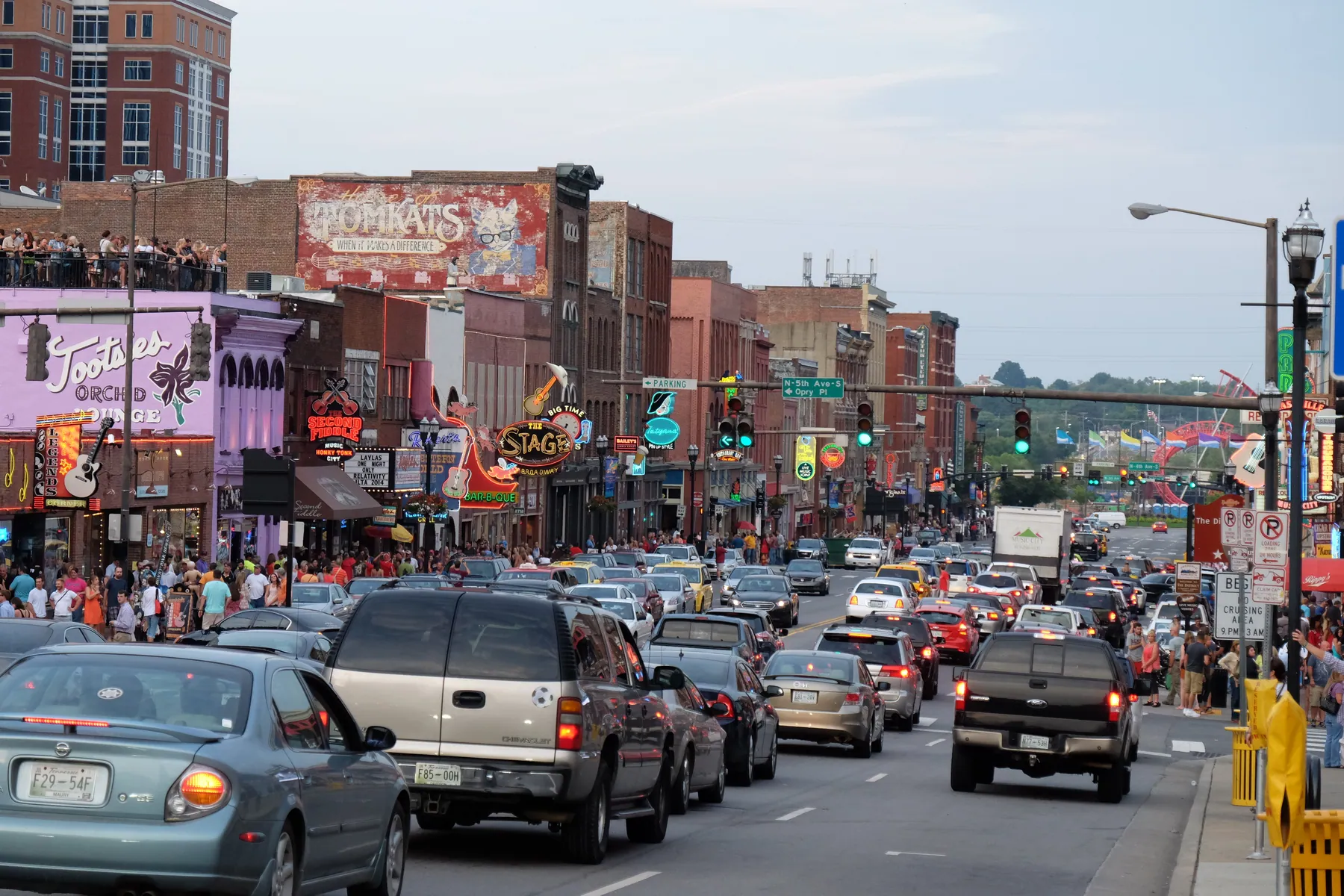
How Lower Broadway Became Honky Tonk Highway
Lower Broadway, the blocks between the Cumberland River and Fifth Avenue, sold furniture, hardware and feed long before it sold beer and live country music. The change took most of a century: the Grand Ole Opry moving in around the corner, a long slump after it left, and a revival that started in the 1990s.
A Commercial Street by the River
Broadway began as Broad Street, one of the first east-west roads in Nashville, and its eastern end met the shipping docks on the Cumberland River. The National Register nomination for the Broadway Historic District, written in 1979, says furniture stores were in business on lower Broadway as early as 1870 and that by the turn of the century the street had become a center of the trade. A 1916 pamphlet from the Broadway Business Men's Association called it famous as a furniture market.
Hardware stores and feed and grain dealers worked the same blocks, and the Merchants Hotel opened in 1892 to house the business travelers who came to buy. In the early 20th century, car dealers and auto shops moved in too, and the street was known for a time as Auto Row.
Furniture held on. When the nomination was written, Broadway was still a local center of the trade, and two companies, H. Brown and Harley-Holt, had been in business at the same addresses since 1902 and 1906.
The Opry Comes to the Ryman
Music arrived in stages. Jimmie Rodgers performed in bars along Broadway near the river in the 1930s, and in the 1940s the Grand Ole Opry moved into the Ryman Auditorium on Fifth Avenue North, next to the Broadway blocks. Soon after, according to the nomination, Broadway became home to a cluster of Opry-related businesses.
Ernest Tubb, the Opry star known as the Texas Troubadour, founded his record shop in 1947, and from 1951 it was home to the Midnight Jamboree, a radio show broadcast live from the store after the last Saturday night Opry show. The nomination credits the program with giving Elvis Presley and Loretta Lynn their first radio exposure.
In the late 1950s, steel guitar players Shot Jackson and Buddy Emmons set up the Sho-Bud steel guitar business in a Broadway building that is now Robert's Western World. It made and sold steel guitars there into the early 1980s.
Tootsie's and the Alley Door
In 1960 Hattie Louise "Tootsie" Bess bought a bar called Mom's. A painter surprised her by painting the outside purple, and the bar became Tootsie's Orchid Lounge. Its back door sits across the alley from the Ryman's stage door, and Opry performers and their fans made it a regular stop.
For nearly 20 years Bess served what the nomination calls "music, beer and sympathy," and she kept generous credit terms for musicians who were down on their luck. Early customers included Willie Nelson, Patsy Cline, Kris Kristofferson, Roger Miller, Mel Tillis and Waylon Jennings. Bess died in 1978 and was buried in an orchid gown, in an orchid-colored casket.
The Slump After 1974
The Opry left the Ryman in 1974 for a new Opry House east of downtown, and Broadway's popularity fell. When the Broadway nomination was written in December 1979, it described physical decay, unsightly signs and unsympathetic changes to the buildings, and noted that the Merchants Hotel now served a less substantial clientele.
The same document argued that the street still kept the scale and much of the original detail of a late 19th-century commercial main street, with a mix of building styles found nowhere else in Nashville for more than a single block on both sides of the street. The Broadway Historic District, covering Broadway between Second and Fifth avenues, was listed on the National Register on July 18, 1980. Tootsie's and the Ernest Tubb Record Shop stayed open through the lean years.
The 1990s Revival
The turn came in the 1990s. Robert Moore converted his Robert's Rhinestone Western Wear store into a venue with live music, food and beer, and the band BR549 played a four-hour gig there every night that drew press attention and led to opening slots for major country acts. The band released Live From Robert's in 1996.
Gaylord Entertainment reopened the renovated Ryman on June 4, 1994, and the Nashville Arena, now Bridgestone Arena, opened at 501 Broadway on December 18, 1996. The Nashville Predators have played there since 1998. In January 1999 the Opry began returning to the Ryman for winter runs, and the return of Opry shows helped bring the street back to life.
That same year Jesse Lee Jones bought Robert's to keep it the home of traditional country music, and its house band, Brazilbilly, has played there for more than 30 years. Tootsie's marked its 50th anniversary on November 7, 2010, with performances at the Ryman.
Honky Tonk Highway Today
The Broadway Historic District now goes by a second name, Honky Tonk Highway. The city's tourism office describes a honky tonk as a place with at least one stage, cold drinks and a party that runs all day, every day. Artists who got early starts playing these rooms include Willie Nelson, Johnny Cash, Kris Kristofferson, Blake Shelton, Dierks Bentley and Gretchen Wilson, and Terri Clark started singing at Tootsie's in 1987.
The Ernest Tubb Record Shop closed on May 3, 2022, after a 75th anniversary celebration. A group that includes Tubb's grandson Dale bought the rights, reopened the store at 417 Broadway and revived the Midnite Jamboree. The shop now has four floors of live music, a rooftop bar over Broadway and a vinyl shop.
From the lofts, the 400 block of Broadway, with Robert's at 416, Tootsie's at 422 and the Ernest Tubb Record Shop at 417, is about 0.4 mile, an 8-minute walk. Bridgestone Arena is about 0.5 mile, a 10-minute walk.
Questions
What is Honky Tonk Highway?
It is the popular name for the Broadway Historic District, the blocks of Broadway between Second and Fifth avenues lined with live-music bars. The district was listed on the National Register of Historic Places in 1980.
When did Lower Broadway come back?
In the 1990s. BR549's nightly sets at Robert's drew press attention, the Ryman reopened in 1994, the arena opened in 1996, and the Opry began winter runs at the Ryman in 1999.
Is the Ernest Tubb Record Shop open?
Yes. It closed in May 2022 and has since reopened at 417 Broadway with live music on four floors, a rooftop bar and records for sale.
How far is Lower Broadway from Union Street Lofts?
About 0.4 mile to the 400 block, an 8-minute walk.
Sources
- Broadway Historic District, National Register of Historic Places nomination (1979)
- Broadway (Nashville), Wikipedia
- Tootsie's Orchid Lounge, Wikipedia
- Robert's Western World, Wikipedia
- Ernest Tubb Record Shop, Wikipedia
- Ernest Tubb Record Shop, official site
- Ryman Auditorium, Wikipedia
- Bridgestone Arena, Wikipedia
Checked October 6, 2026.
Photo: Cheryl A. Austin, CC BY-SA 4.0, via Wikimedia Commons. Cropped.
More journal
All 10The Story of Nashville Hot Chicken
Nashville hot chicken is fried chicken coated in a cayenne-heavy paste and served on white bread with pickle slices.
Tennessee Whiskey Near Downtown Nashville
Tennessee whiskey has its own definition in state law, a long gap during Prohibition and a revival that took off after 2009.
How the Grand Ole Opry Moved From the Ryman
For about 31 years the Grand Ole Opry broadcast from the Ryman Auditorium, about a 6-minute walk from the lofts.