A Short History of Printers Alley
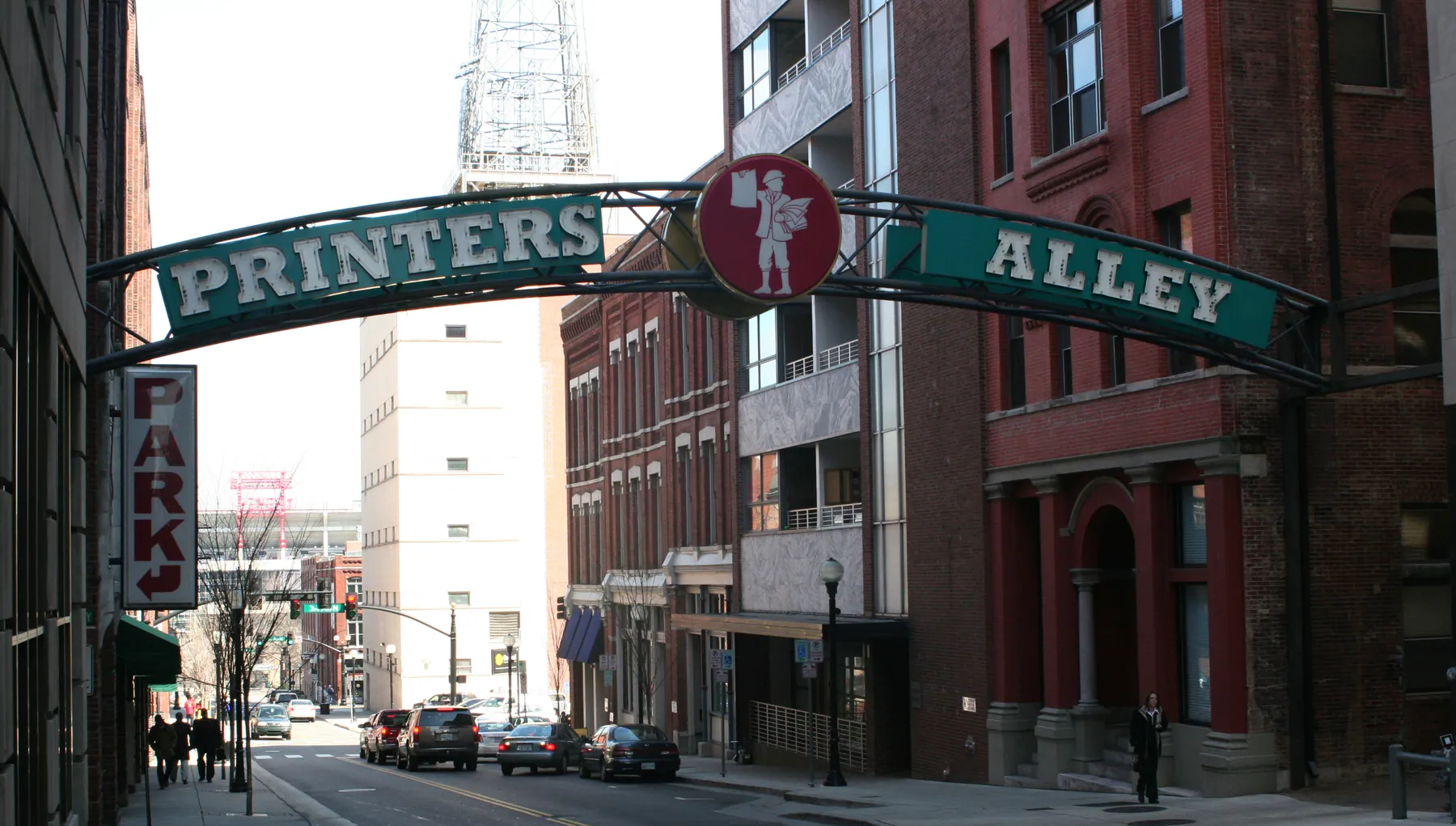
Printers Alley is the narrow lane between Third and Fourth avenues in downtown Nashville, on the same block as the lofts. Over almost 200 years it has been a printers' service lane, the back door of a saloon district, a Prohibition hideout and a nightclub strip, and the buildings along it still show each stage.
Black Horse Alley
The alley began as a service lane. The 1982 National Register nomination for the Printers Alley Historic District says the area had been laid out by 1831, when the office of one of Nashville's early leading newspapers already stood beside it. By 1853 there were three newspapers and at least one other printing office around it.
Its old name survives in the deeds. An 1855 deed describes a printing office on a parcel bounded by Deaderick Street and Black Horse Alley. The 1866 deed for the same parcel calls the lane Black Horse or Printers Alley, and two newspapers listed their address on the alley itself, one in 1865 and one in 1866.
Most printers and publishers never fronted the alley. Their doors faced Church Street and the avenues, and the alley handled the loading of goods and the hand-off of newspapers to carriers. The nomination puts the trade's peak at 1915, when 13 publishers and 10 printers worked in the area, including offices of the Nashville Banner and The Tennessean.
The Men's Quarter
Fourth Avenue North was called Cherry Street until December 1904, when the city council passed a bill renaming the north-south streets west of the Cumberland River. In the 1890s, the block of Cherry Street between Church and Union became the Men's Quarter, where a man could find saloons, billiard halls, restaurants, cigars and tobacco, barber shops, bath houses and loan offices. According to the nomination, a respectable woman would refuse to be seen there.
Three buildings formed its core: the Climax Saloon (1887), with a galvanized iron front that was probably ordered from a catalog; the Utopia Hotel (1891) at 206 Fourth Avenue North; and the Southern Turf (1895) at 222 Fourth Avenue North, which the nomination calls the most elegant of the saloons in Nashville. The survey done for the nomination found false walls in third-floor bedrooms of the Climax, probably added while it was still a saloon, where women could hide during a raid.
The Buildings Along the Alley
The district's 15 buildings date from 1874 to 1929, and most went up between the 1890s and 1905. They range from one to 12 stories and cover a run of styles: Italianate, Romanesque Revival, Victorian Romanesque, Queen Anne, Neo-classical, Chicago and Art Deco. The alley sides are plain brick with arched window openings and loading doors; the nomination notes they have no distinctive details but keep the texture and age of their original materials.
A few of them were firsts for the city. The J. C. Bradford Building at 170 Fourth Avenue North went up in 1905 for the First National Bank as Nashville's first skyscraper and first steel-frame building, 12 stories tall. The Noel Block Garage at Church Street and Third Avenue, built in 1926 with room for 320 cars, was the first parking garage in Nashville. On Third Avenue, a fire in January 1892 destroyed almost the whole west side of the block between Church Street and Bank Alley, and the five buildings lost were rebuilt as furniture stores.
Prohibition and the Mixer Bars
Tennessee enacted statewide prohibition in 1909, and together with the reform movement of the period it ended the Men's Quarter. Many of the businesses kept going in a quieter form. The nomination records a local tradition that at least one speakeasy operated out of a saloon basement with a door onto the alley, and calls it the forerunner of the entertainment district that grew up there later.
Tennessee repealed prohibition in 1937, but liquor still could not be sold by the glass. Owners in the alley worked around that with mixer bars, where customers brought their own bottle and a bartender mixed the drinks.
The Nightclub Strip
In the late 1940s the alley became a nightclub district. Club owners paired dinner with burlesque dancing and live bands at places such as the Captain's Table, the Brass Rail Stables, the Embers, the Black Poodle Lounge, the Voo Doo Lounge and the Rainbow Room. David "Skull" Schulman opened the Rainbow Room in 1948 in the basement of the old Southern Turf, and he came to be known as the Mayor of Printers Alley.
The Nashville Historical Foundation lists Chet Atkins, Boots Randolph, Waylon Jennings, Hank Williams, the Supremes and Jimi Hendrix among the performers who played the alley. One dancer, Heaven Lee, worked at the Black Poodle for ten years in the 1960s and 1970s, and in 1970 she rode a horse down James Robertson Parkway to protest pollution.
The alley also made it onto a record. Paul McCartney mentioned it in "Sally G," the B-side of his 1974 single "Junior's Farm."
Decline and the Last Printer
Full legalization of liquor by the drink in Nashville in the late 1960s hurt business in the alley.
The printing trade left at about the same time. The last printing firm, Ambrose Printing, moved out in the mid-1970s from 162 Fourth Avenue North, a 1905 building put up for the Marshall and Bruce Publishing Company.
In 1982 the National Register listed the Printers Alley Historic District: about five acres with 15 buildings dated 1874 to 1929, 13 of them contributing. The nomination noted that the former Men's Quarter, now facing the alley, had again become a major entertainment district over the previous 20 years.
Skull's Rainbow Room and the Alley Today
Schulman was still running the Rainbow Room at 80. In January 1998 he was attacked while working alone at the club and died the next day, and the club closed. It reopened in June 2015 as Skull's Rainbow Room, a 140-seat restaurant and bar, after a new owner bought and renovated the Southern Turf building. Historic Nashville Inc. holds a preservation easement on the building, and the club operates today at 222 Printers Alley.
The Cultural Landscape Foundation describes the alley as a narrow, paved, pedestrian lane lined with brick facades, cast-iron balconies and window boxes, and a painted Printers Alley sign arches over the entrance. From the lofts on Union Street it is about 0.1 mile, a 2-minute walk.
Questions
Why is it called Printers Alley?
It served the printing and publishing businesses on the surrounding streets. Deeds call it Black Horse Alley in 1855 and Black Horse or Printers Alley by 1866, and in 1915 the area held 13 publishers and 10 printers.
Is Printers Alley a historic district?
Yes. The Printers Alley Historic District was listed on the National Register of Historic Places on August 26, 1982. It covers the alley block between Bank Alley and Church Street, plus a few buildings just beyond it.
How far is Printers Alley from Union Street Lofts?
About 0.1 mile, a 2-minute walk. The lofts are on Union Street, on the same block as the alley.
Sources
- Printers Alley Historic District, National Register of Historic Places nomination (1982)
- Printer's Alley, Wikipedia
- Printer's Alley Historic District, The Cultural Landscape Foundation
- Printers Alley, Nashville Historical Foundation
- Skull's Rainbow Room history, Nashville Scene
- Skull's Rainbow Room, official site
- From Market to 2nd Ave, Nashville Public Library
Checked October 6, 2026.
More journal
All 10The Printing Trade That Named Printers Alley
Before it was a nightlife strip, the block around Printers Alley was where Nashville set type and ran presses.
How Lower Broadway Became Honky Tonk Highway
Lower Broadway, the blocks between the Cumberland River and Fifth Avenue, sold furniture, hardware and feed long before it sold beer and live country music.
The Story of Nashville Hot Chicken
Nashville hot chicken is fried chicken coated in a cayenne-heavy paste and served on white bread with pickle slices.